COGでの研究活動に興味のある皆様へ。
Computational Optics Group の研究紹介スライドを公開します。

 Our colleague Kazuhiro Kurokawa reported in vivo imaging of choriocapillaris by using Doppler optical coherence tomography (Doppler OCT) equipped with adaptive optics (AO) retinal scanner. Doppler OCT have been long time utilized for the investigation of retinal vasculature. Despite of its high ability for the visualization of vasculature, it was not possible to visualize choriocapillaris mainly because of its very small dimensions. We overcame this issue by using a custom made AO retinal scanner.

 Our colleague Masahiro Miura from Tokyo Medical University recently reported our first trial of quantification of choroidal blood flow. He utilized a custom made Doppler optical coherence tomography with a probe beam at 1.0-um band. The Doppler signal at the choroid was further processed with a structural structural information of the vessel. Finally an absolute velocities of choroidal blood flow in in vivo human eyes were presented.

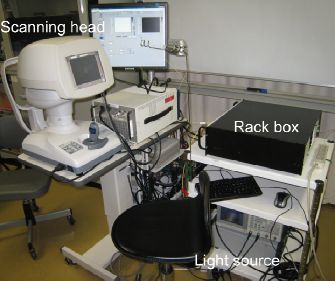 Our colleague Yiheng Lim recently reported a clinical prototype of polarization sensitive optical coherence tomography (PS-OCT) specially designed for the investigation of anterior eye segments. This system based on our developed high-speed Jones matrix OCT methodology, and integrated with a scanning head specially designed for anterior eye imaging. This clinical prototype provides semi-automatic alignment function and possesses a compact, office-compatible size. Several clinical cases were investigated to prove the clinical utility.

 Tapio Fabritius (Oulu University, Finland) recently published a paper in Optics Express in which the authors investigated the utility of optical coherence tomography (OCT) for the characterization of wettability of materials. The study presented was a collaboration between Oulu University and Computational Optics Group at the University of Tsukuba.
 Our colleague Masahiro Yamanari recently reported a new polarization sensitive optical coherence tomography (PS-OCT) for retinal and choroidal imaging. This new PS-OCT utilized a probe beam with 1-micron wavelength enabled high-penetration to the choroid, and a full range measurement scheme based on the modulation of reference beam of OCT (BM-scan). This system enables detailed investigation of birefringence property of the deep posterior eye.
 Our colleague Kazuhiro Kurokawa recently reported adaptive optics optical coherence tomography (AO-OCT) for posterior eye imaging. This AO-OCT uses one-micrometer wavelength probe, and is the world first demonstration of high-penetration AO-OCT.
 The biggest annual event of OCT community begins. BiOS, a part of SPIE Photonics West starts on Jun. 23rd. in San Francisco. Almost all members of COG are now rushing into that city. We have 7 oral presentations including 6 from our core member and 1 from our collaborator. See this page to see the abstracts and add our presentations to your conference agenda. Come and see our talks!

 Franck Jaillon from COG in the University of Tsukuba demonstrated a new full range spectral domain optical coherence tomography (OCT), so called parabolic BM-scan method. This method is a variation of full-range OCT based BM-scan method, but possesses higher tolerance to the sample motion and higher dynamic range of Doppler measurement. In this paper, in vivo investigation of human eye was performed, and it was found that this parabolic BM-scan method is useful for office-based in vivo measurements. The details of this method were published in Optics Express.
